All posts by Jason McNally

Remembering My First Trumpet Lessons

It’s amazing how the memories of my early trumpet lessons with my dad have stuck with me over the years.  The trumpet was the first instrument I started on at age 7.  I later took up piano with private teachers and, for the most part, eventually gave up trumpet after finishing high school.

In spite of dedicating my life to the keyboard instrument, I have indelible musical memories of pieces and exercises that I started with dad on trumpet.  For instance, I can still picture him writing out one of the first Clark exercises in my manuscript book, as well as basic note values, and the melody line to The Old Rugged Cross (what I wouldn’t give to find that notebook!).  Throughout the years, I have never lost the love I had for the trumpet.  I don’t know if all (former) trumpet players do this, but whenever I hear a melody, I naturally start fingering the valves of the notes with my fingers, as if I’m playing (sixteen years later!).  These musical experiences must have been so meaningful and formative for me, that the memories have lasted until now.

At some point, I started working out of the Arban trumpet method book, and I remember really loving the longer trumpet solos at the back.  Of course, the most famous is probably Carnival of Venice.  My dad played parts of it for me, and I know I worked on a lot of it and enjoyed impressing the other high school kids in band class; but I know that the lyricism of the music and the beauty of the trumpet sound was what really drew me to it.

I don’t think we realize the significance of what is absorbed and imprinted on young minds at that early age.  I’m so glad that I had a dad who shared his love of music with me and encouraged me…and still does.

In honor of him and those memories, here is Wynton Marsalis playing Carnival of Venice.

Trumpet Tunes of the Organ Variety

As a somewhat recent organ aficionado/player, I have discovered the ubiquitous genre of organ “trumpet tunes”.  These are organ pieces that have a melody which is soloed out on a loud “trumpet” stop (which often go by various names – such as Festival Trumpet, Tuba Mirabilis, Trumpete en Chamade, etc.).

Prior to my organ playing, I knew of the standard trumpet tunes by Stanley, Clarke, Purcell among others that were always played on actual trumpets.  When I started playing weddings, though, I found that I didn’t have a trumpet player, but my organ had an organ stop.  It is easy to find these standard tunes written in organ only arrangements.

If you’re an organist looking for good postlude pieces, these organ trumpet tunes are very versatile and there is such a wealth of them that it would be easy to play a new one every Sunday service- if not for the likelihood of tiring out the congregation on one type of piece.  Many are based on hymn tunes and are written as simple voluntaries for service music.  The shorter ones can be used as hymn introductions or even as regular stanza accompaniments, provided they are written to follow the hymn metrically.

These organ trumpet tunes also allow for a simple change of pace if you happen to actually have a trumpeter on hand.  As the organist, you can simply omit the solo line and let the trumpeter play it.  Congregations always appreciate a thoughtful change of pace from week to week, no matter how small it is.

I suggest looking up some of the organ music of Michael Burkhardt, Michael Helman, or David Johnson for starters.  Here is David Johnson’s popular Trumpet Tune in D:

The Trumpet/Viola Connection

GASP!

This is what most trumpet players would do after reading my latest blog title.  (“how dare you compare us to the joke of the orchestra, etc…”).  So let me clarify – the similarity is not in the instruments themselves, or even in the players.  However, it is in the act of transposition that trumpet players are often called upon to do.

The common trumpet is the B-Flat trumpet.  It is what all grade school students start on and it’s what most people play the majority of the time.  Since we’re in B-Flat, we often need to transpose up one whole step to play in concert pitch.  I am thankful I learned how to do this at a young age, since even though I no longer regularly play the trumpet, I still use this transposition technique often.  Here is the reason why:

Viola players read in alto clef.  That means that middle C is on the third line of their staff. alto clef C

If you are used to reading in treble clef (as most trumpet players are), that note looks like a B (above middle C).   But since trumpet players are so used to transposing up a step, we can take that note up a step, and then DOWN AN OCTAVE- to middle C.  All we have to do is add that additional step of down an octave, and trumpet players can read alto clef very easily.

This technique has helped me alot since I went to college.  Having to sight sing in 4 different clefs, all I would think was to just sing up a step whenever I saw alto clef.  I also sometimes need to play open scores on piano utilizing these other clefs.  And if you can read alto clef, you can train yourself to read tenor clef.  Basically, tenor clef is DOWN a step (from what the note is in treble), then down an octave.

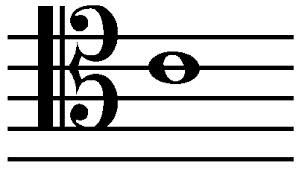
tenor clef c

In the picture above, the 4th line note would be D in treble clef, but it is middle C in tenor clef.

So, the next time you see your friendly neighborhood viola player, let them know you understand what it’s like to read in alto clef.  And maybe even try to cut down on those viola jokes.

Ensemble…Part 2

Some more thoughts on the “art of ensemble”:

After hearing an absolutely flawless and inspiring violin/piano duo concert last night, I had some more thoughts on the “art of ensemble”:

The husband and wife duo that I heard were phenomenal.  They played sonatas by Debussy, Saint-Saëns, and the Sonatensatz by Brahms.  I expected the performance to be good given their educational background, but they far exceeded my expectations.  Besides their depth of expression, there was not a split second where they were not completely together the entire evening.

Besides the obvious reason that they are both exceptional individual players, in my opinion it is the time spent learning and discovering the pieces together that makes the duo so enjoyable to listen to.  I think you can take any “all-star” chamber group of famous musicians, put them together, and you will get a pretty good performance.  But there is something deeper and more meaningful in performances when the group rehearses pieces for long periods of time.  “Living” with a piece, the ensemble becomes “in tune” with each other.  Rather than two or three different interpretations, you get a completely uniformity of purpose in the musical expression.

Of course, this goal is not always possible, given our varying situations of gigs, short term accompanying jobs, etc.  However, I think if we are looking for the most satisfying musical experience, we should strive to form consistent ensembles that we can work with on a regular basis.  In this way, we can learn pieces together, come back and revisit pieces we’ve done before, and in so doing, improve our “ensemble” playing!

The Art of Listening and “Ensemble”

I recently played an organ 4-hand piece with another organist, a player whom I will say right off the bat, is much more accomplished than I am on the instrument.  It was a real treat for me to play with her, and I feel like I learned a great deal from the collaboration.

We rehearsed and performed an organ duo by J.C. Bach (one of J.S. Bach’s sons).  This was not only the first time I had played an organ duet with someone, it’s also the first time I had played anything by J.C. Bach on the organ.  I have played plenty of Classical era pieces on the piano.  However, there are stylistic things that are done on the organ that differ greatly from the piano.  Phrasing, articulation, and dynamic contrast are just a few of the musical elements that are achieved very differently on the two instruments.  I have not been trained much on the organ, so I find myself extremely eager to hear accomplished organists play.  With the absence of instruction, we learn primarily through listening and being exposed to other performances.

The only way we could create a good “ensemble” at the organ was to listen to each other.  I felt like I didn’t have a good grasp on style for this piece, so I listened very intently to my duo partner.  If she phrased a passage in a certain way, I would need to follow it and phrase the same way.  The piece has a lot of dialogue between the primo and secondo parts, so this method worked well.  I basically learned by imitation.

The importance of listening in any kind of musical ensemble cannot be overstated. Every group that plays together, whether it’s a string quartet, brass quintet, small choir or other combination is making music TOGETHER.  Without a director, the individual musicians of the ensemble need to be involved that much more, discussing how each part interacts with all the other parts.  The more experienced and accomplished musicians obviously should be influencing the less accomplished members of the group.  But there needs to be a constant awareness and understanding of ensemble.  A few things to think about in rehearsal:

1. How does my part relate to the other parts at this spot in the piece?  Do I have a motive that has been heard before?  How was it phrased/articulated previously?

2. Are we all breathing together where possible?

3. When am I in unison/octaves with another voice/part?  Are we listening and tuning to each other?

4.  Why not try playing the piece at 2/3 tempo or even 1/2 tempo to see how the parts relate to each other?

5. Get your hands on as many recordings of other ensembles playing the same piece.  Avoid listening to only one interpretation.


Hope this helps!


Extreme Long Tones

I remember my dad always practicing long tones growing up, telling me to do them, and telling his other students the same.  I know he has found them to be super effective in building endurance and stamina in the embouchure.

I found this “extreme” long tone exercise from Cat Anderson (jazz trumpeter with Duke Ellington) on the website http://brassmusician.com/              

Cat Anderson was known for his huge range (5 octaves) and credited his “20 Minute G” Exercise for that fact.  See below for the exercise as explained by Jon Gorrie.

“20 Minute G” Exercise

Like a whisper

In his method book from 1973, Cat Anderson instructs the student to play a 2nd line G (concert F) “like a whisper” for 20 minutes. The student is allowed to breathe when necessary, and is also allowed to take the mouthpiece off the lips when doing so.

More than just a high note exercise

Many ‘high-note’ players, including Anderson himself, have claimed that the “20 minute G” is the secret to their upper register. Although practised correctly, this exercise can be much more than an upper register exercise. Played with relaxed breathing and a suitable rest period afterwards, the “20 minute G in a whisper” may aid in overcoming excessive mouthpiece pressure, building endurance, aid control and articulation, and, as Anderson mentions, improve upper register playing.

Resolving tension

The thought behind this is that whilst carrying out this one simple exercise, your mind is free to focus on areas of your body where you are holding tension. Where tension is found, it can then be gradually resolved, leading to a more efficient overall physical ‘setup’.

How to get started

To get started with the “20 minute G”, one suggestion is to begin with the “30 second G”, increasing the duration of the exercise over several days to 1 minute, 2 minutes, 5 minutes, 10 minutes, and so on.

Why Not Church?

We recently finished all the Christmas/Advent services at my church for 2013.  We did a wonderful piece by Shawn Kirchner (Behold, New Joy!) which was arranged for choir, brass octet, and organ.  It was great having outside musicians add to our musical and spiritual experience this December.  Now that we’re into the new year, I’m more resolved to have instrumentalists play regularly in our church services.

Having guest musicians play in church is a wonderful symbiotic relationship that we (as church musicians/staff and as freelance musicians) don’t take advantage of enough, in my opinion.

1) From the perspective of the church organist (of which I am one), it takes pressure off me by having a soloist or group of musicians, rather than just organ leading all of the service.

2) Given that it’s harder and harder to find good freelance work, instrumentalists can find an easy Sunday morning gig to earn a little extra cash.  There is usually minimal preparation required and not much time involved to play a service or two (rather than sleep in!) on a Sunday.

3) The congregation is always very appreciative of any extra artistic or musical element that is added to the service.  Even as an “every Sunday” musician, I always feel like I am helping the congregation worship and get more out of the service.  So as a guest musician, you will always feel especially welcome and valued and may even find other gigs simply from playing a few times a year in a local church.

Do a search for the local churches in your area, send an email to the minister/director of music, and let them know you’re available to play special music when needed.  Most directors won’t even require an audition!

Are Spit Valves Necessary?

I was thinking about spit valves Thursday night, and the general surprise and slightly amused displeasure of our church choir members at the sight of brass players emptying their instruments.  After playing a choir/brass/organ rehearsal a couple days ago, I noticed the usual puddles of water by the brass players’ chairs.  It got me thinking about why trumpets simply have spit valves and other brass instruments need to remove slides more frequently and empty their instruments that way.  Is there a benefit to either method, and could a trumpet be cleaned/emptied the same way as say, a French horn? Or is there even another way to clean the instrument?

I came across this blog, The Trumpet Gearhead which gives answers to frequently asked questions about trumpets and trumpet playing.  Here is the blog author, Jim Donaldson’s answer on emptying the trumpet without using the spit valves:


Q: How do I empty all the water from my trumpet without using the spit valves?

A:

1. Hold trumpet as normal;

2. Tilt 90 degrees to the left (i.e., counter clockwise) so that the valves are horizontal, with the valve buttons pointing to your left;

3. Angle the bell up a few degrees;

4. Press down 3rd valve and blow (some folks find it best to remove the mouthpiece before blowing);

5. Press down 2nd valve and blow;

6. Press down 1st valve and blow;

7. Rotate 90 degrees counter clockwise so that valve buttons are pointing straight down;

8. Tilt bell downwards and lots of water runs out clearing all parts of the instrument!

This employs the the same technique used by french horn players. It really does work and can be far faster than removing slides or even operating 2 water keys.


Just a Closer Walk with Thee

Jason here.  One of my favorite brass quintet arrangements is Just a Closer Walk with Thee as popularized by the Canadian Brass.  The arrangement emulates the New Orleans jazz style and divides the tune into two parts- the first part a dirge portraying the slow walk to the grave; the second part a joyful portrayal of the deceased being received into heaven (…at least that’s how my interpretation of it goes…)

I remember going to hear the Canadian Brass in the 90′s at the Academy of Music in Philadelphia with members of my dad’s brass quintet, The Jubilant Brass, and their families.  I can’t really remember if they played this tune that day, but I do remember that it was a fun concert.

If you’re looking for a local group you can book for a great evening, look no further than The Jubilant Brass.  They play a huge variety of different music- from sacred, to classical, to jazz.  They even do Just a Closer Walk oftentimes, and in my opinion, my dad does an even better job with the trumpet solo than Fred Mills!  Unfortunately, no video of the Jubilant Brass performing it exists, so you’ll just have to book them for a concert to hear it (go here)…in the meantime, “make do” with the Canadian Brass.


Soli Deo Gloria

sdg

Besides studying their music, there is a lot to be learned from the actual lives of the great composers.  I’ve always been fascinated by composers’ lives and often fantasize about being in their time, seeing them day to day, and what they were actually like.  The “Big 3″ of Bach, Mozart, and Beethoven tend to be deified to such a degree that we can’t imagine the musical world without them.  We may be right to think this way, but they were human just like us, and I think we sometimes lose sight of that fact- when we play a glorious piece by Mozart for example, that seems as though it were given straight from the heavens.  This is why I enjoy reading about their lives- it helps me understand their humanity and their strivings…what they were reaching for, and what inspired them.

Being a church musician myself, I’ve always been intrigued by J.S. Bach and the fact that virtually everything he wrote was in service to the Lutheran church.  This would be unheard of nowadays.  Sure, there are full time church arrangers and composers, but they are not generally composing on a weekly basis.  Bach managed to write new music every week for services.  Was he simply churning out pieces as fast as possible for a paycheck, or was there something else driving him?

It turns out that Bach was in fact a very religious man.  Some other composers such as Schubert and Beethoven wrote religious works and masses, but were not overtly religious themselves from what we can tell.  But Bach’s faith is evidenced by his repeated use of one simple phrase – Soli Deo Gloria.  To God Alone be the Glory.  Bach wrote this phrase on every work he completed, even non religious pieces.   He was not writing only for his church- he believed in the greater responsibility of personally giving glory to God through his music.  He even took this idea a step further with the following statement (and I believe I’m paraphrasing):  “There are two purposes of music – to give glory to God, and the refreshment of the soul.”

This is inspiring to me as I play weekly at church, as I know it is to countless others.