
Category Archives: blogs

Ensemble…Part 2

Some more thoughts on the “art of ensemble”:

After hearing an absolutely flawless and inspiring violin/piano duo concert last night, I had some more thoughts on the “art of ensemble”:

The husband and wife duo that I heard were phenomenal.  They played sonatas by Debussy, Saint-Saëns, and the Sonatensatz by Brahms.  I expected the performance to be good given their educational background, but they far exceeded my expectations.  Besides their depth of expression, there was not a split second where they were not completely together the entire evening.

Besides the obvious reason that they are both exceptional individual players, in my opinion it is the time spent learning and discovering the pieces together that makes the duo so enjoyable to listen to.  I think you can take any “all-star” chamber group of famous musicians, put them together, and you will get a pretty good performance.  But there is something deeper and more meaningful in performances when the group rehearses pieces for long periods of time.  “Living” with a piece, the ensemble becomes “in tune” with each other.  Rather than two or three different interpretations, you get a completely uniformity of purpose in the musical expression.

Of course, this goal is not always possible, given our varying situations of gigs, short term accompanying jobs, etc.  However, I think if we are looking for the most satisfying musical experience, we should strive to form consistent ensembles that we can work with on a regular basis.  In this way, we can learn pieces together, come back and revisit pieces we’ve done before, and in so doing, improve our “ensemble” playing!
The Art of Listening and “Ensemble”

I recently played an organ 4-hand piece with another organist, a player whom I will say right off the bat, is much more accomplished than I am on the instrument.  It was a real treat for me to play with her, and I feel like I learned a great deal from the collaboration.

We rehearsed and performed an organ duo by J.C. Bach (one of J.S. Bach’s sons).  This was not only the first time I had played an organ duet with someone, it’s also the first time I had played anything by J.C. Bach on the organ.  I have played plenty of Classical era pieces on the piano.  However, there are stylistic things that are done on the organ that differ greatly from the piano.  Phrasing, articulation, and dynamic contrast are just a few of the musical elements that are achieved very differently on the two instruments.  I have not been trained much on the organ, so I find myself extremely eager to hear accomplished organists play.  With the absence of instruction, we learn primarily through listening and being exposed to other performances.

The only way we could create a good “ensemble” at the organ was to listen to each other.  I felt like I didn’t have a good grasp on style for this piece, so I listened very intently to my duo partner.  If she phrased a passage in a certain way, I would need to follow it and phrase the same way.  The piece has a lot of dialogue between the primo and secondo parts, so this method worked well.  I basically learned by imitation.

The importance of listening in any kind of musical ensemble cannot be overstated. Every group that plays together, whether it’s a string quartet, brass quintet, small choir or other combination is making music TOGETHER.  Without a director, the individual musicians of the ensemble need to be involved that much more, discussing how each part interacts with all the other parts.  The more experienced and accomplished musicians obviously should be influencing the less accomplished members of the group.  But there needs to be a constant awareness and understanding of ensemble.  A few things to think about in rehearsal:

1. How does my part relate to the other parts at this spot in the piece?  Do I have a motive that has been heard before?  How was it phrased/articulated previously?

2. Are we all breathing together where possible?

3. When am I in unison/octaves with another voice/part?  Are we listening and tuning to each other?

4.  Why not try playing the piece at 2/3 tempo or even 1/2 tempo to see how the parts relate to each other?

5. Get your hands on as many recordings of other ensembles playing the same piece.  Avoid listening to only one interpretation.


Hope this helps!


International Trumpet Guild 2014 in Valley Forge!

The International Trumpet Guild’s 2014 national conference happens to be in Valley Forge!  It’s exciting to have the conference so close to home this year.  Most of the events and activities will be from May 20-24, 2014 at Valley Forge Convention Center.

I was checking out the official website and some of the familiar artists performing are:  Canadian Brass and two ensembles from my alma mater, West Chester University.  Eric Ewazen will be one of the presenters.  For more information, visit http://www.itg2014.com/

Extreme Long Tones

I remember my dad always practicing long tones growing up, telling me to do them, and telling his other students the same.  I know he has found them to be super effective in building endurance and stamina in the embouchure.

I found this “extreme” long tone exercise from Cat Anderson (jazz trumpeter with Duke Ellington) on the website http://brassmusician.com/              

Cat Anderson was known for his huge range (5 octaves) and credited his “20 Minute G” Exercise for that fact.  See below for the exercise as explained by Jon Gorrie.

“20 Minute G” Exercise

Like a whisper

In his method book from 1973, Cat Anderson instructs the student to play a 2nd line G (concert F) “like a whisper” for 20 minutes. The student is allowed to breathe when necessary, and is also allowed to take the mouthpiece off the lips when doing so.

More than just a high note exercise

Many ‘high-note’ players, including Anderson himself, have claimed that the “20 minute G” is the secret to their upper register. Although practised correctly, this exercise can be much more than an upper register exercise. Played with relaxed breathing and a suitable rest period afterwards, the “20 minute G in a whisper” may aid in overcoming excessive mouthpiece pressure, building endurance, aid control and articulation, and, as Anderson mentions, improve upper register playing.

Resolving tension

The thought behind this is that whilst carrying out this one simple exercise, your mind is free to focus on areas of your body where you are holding tension. Where tension is found, it can then be gradually resolved, leading to a more efficient overall physical ‘setup’.

How to get started

To get started with the “20 minute G”, one suggestion is to begin with the “30 second G”, increasing the duration of the exercise over several days to 1 minute, 2 minutes, 5 minutes, 10 minutes, and so on.

The Message Behind the Music

There is no shortage of amazing brass players in the world.  There are those whose technical prowess is just simply unbelievable.  However, I find that these technical feats are not really what I’m drawn to while listening to performances.

One of my first trumpet teachers, Derek Smith, said in the liner notes to his CD, Heavenly Gales, that his playing was always about the message behind the music.   In his case, playing for the Salvation Army Staff Band, it was about the Christian message.   When I listen to his recordings, I hear the love that he has for the Savior, coming through in the melodies he plays.  It is the message that draws me in, and I believe, countless others as well.

Another great musician, Samuel Hsu once said, “Technique is nothing; love is everything.”  Without the personal expression of the performer, there is something missing in the music.  Sure, it may sound good, but it won’t touch the listener.

There is a wonderful recording by Derek Smith’s son, Philip Smith, of the Gershwin tune, Someone to Watch Over Me.  Even though it was originally intended as a secular tune, I feel that Phil has made it about the Lord watching over him, in his daily life.  It may just be my own feelings, but have a listen for yourself.


Why Not Church?

We recently finished all the Christmas/Advent services at my church for 2013.  We did a wonderful piece by Shawn Kirchner (Behold, New Joy!) which was arranged for choir, brass octet, and organ.  It was great having outside musicians add to our musical and spiritual experience this December.  Now that we’re into the new year, I’m more resolved to have instrumentalists play regularly in our church services.

Having guest musicians play in church is a wonderful symbiotic relationship that we (as church musicians/staff and as freelance musicians) don’t take advantage of enough, in my opinion.

1) From the perspective of the church organist (of which I am one), it takes pressure off me by having a soloist or group of musicians, rather than just organ leading all of the service.

2) Given that it’s harder and harder to find good freelance work, instrumentalists can find an easy Sunday morning gig to earn a little extra cash.  There is usually minimal preparation required and not much time involved to play a service or two (rather than sleep in!) on a Sunday.

3) The congregation is always very appreciative of any extra artistic or musical element that is added to the service.  Even as an “every Sunday” musician, I always feel like I am helping the congregation worship and get more out of the service.  So as a guest musician, you will always feel especially welcome and valued and may even find other gigs simply from playing a few times a year in a local church.

Do a search for the local churches in your area, send an email to the minister/director of music, and let them know you’re available to play special music when needed.  Most directors won’t even require an audition!

Endurance and Loud Playing

Here is a helpful mini-lesson I found on the blog called The Trumpet Gearhead.  The short article on endurance and loud playing is actually some instruction from non other than David Bilger, principal trumpet of the Philadelphia Orchestra.  I plan to try these out soon!


Editor’s note: The following excerpt is written by David Bilger and used with his permission. It describes an exercise for improving power and endurance that Mr. Bilger learned from Renold Schilke.  Mr. Bilger currently is Principal Trumpet of the Philadelphia Orchestra, and was previously Principal of the Dallas Symphony. He currently teaches at The Curtis Institute of Music and Temple University in Philadelphia.

Endurance:

As is the case with range, endurance is also a combination of many of the topics we have already touched upon, and will benefit from many of the same etudes. The two other things that will most quickly improve endurance are efficiency and loud practice.

1. Efficiency is a necessity for any brass player. Playing the trumpet is extremely physical, and efficient playing will reduce the demands on the player. Efficiency can be achieved by taking care of the following:

  • Always use a good volume of air, and high air speed
  • Always play with your embouchure set
  • Do not use excessive pressure
  • Practice upper body relaxation
  • Always think about what you are doing while you play


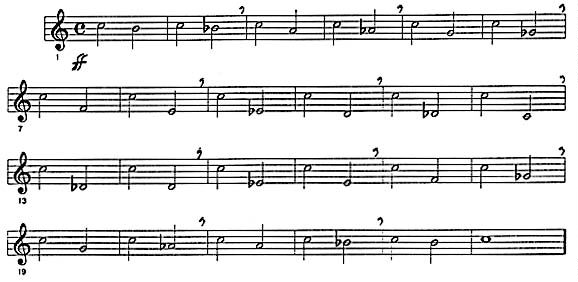
2. Loud practice is another part of trumpet playing that is often overlooked. Remember, when practicing at loud dynamic levels, always keep your sound from distorting, and never cause yourself physical pain. Do not use excessive pressure! Orchestral excerpts are a good source of loud material, as are the Brandt Orchestral Etudes. Perhaps the best resource for loud playing are the Schilke Power Exercises. Playing 5 minutes of these a day will be all you need to develop the necessary strength for increased endurance.

Mr. Bilger writes specifically about this exercise:

I had the pleasure and honor of working with Mr. Schilke for a week at the Banff Centre in 1980 when he was hanging out with the Canadian Brass who were on the faculty there. During that week he showed me the power exercises that I outlined in my master class materials. I have all my students do them!

They should be played at quarter note = 60, and with huge quick breaths after every four half notes. And most importantly, they should be played as loud as the player can control, with attention being paid to stability of sound and pitch, as well as dynamic. They are designed for developing an “orchestral” sound, but are of use to all players who want to develop additional power in their playing.

Transpose into different keys.

(right-click and open in new tab/window to get an enlarged view of the exercise)

Power Exercise-Bilger


Are Spit Valves Necessary?

I was thinking about spit valves Thursday night, and the general surprise and slightly amused displeasure of our church choir members at the sight of brass players emptying their instruments.  After playing a choir/brass/organ rehearsal a couple days ago, I noticed the usual puddles of water by the brass players’ chairs.  It got me thinking about why trumpets simply have spit valves and other brass instruments need to remove slides more frequently and empty their instruments that way.  Is there a benefit to either method, and could a trumpet be cleaned/emptied the same way as say, a French horn? Or is there even another way to clean the instrument?

I came across this blog, The Trumpet Gearhead which gives answers to frequently asked questions about trumpets and trumpet playing.  Here is the blog author, Jim Donaldson’s answer on emptying the trumpet without using the spit valves:


Q: How do I empty all the water from my trumpet without using the spit valves?

A:

1. Hold trumpet as normal;

2. Tilt 90 degrees to the left (i.e., counter clockwise) so that the valves are horizontal, with the valve buttons pointing to your left;

3. Angle the bell up a few degrees;

4. Press down 3rd valve and blow (some folks find it best to remove the mouthpiece before blowing);

5. Press down 2nd valve and blow;

6. Press down 1st valve and blow;

7. Rotate 90 degrees counter clockwise so that valve buttons are pointing straight down;

8. Tilt bell downwards and lots of water runs out clearing all parts of the instrument!

This employs the the same technique used by french horn players. It really does work and can be far faster than removing slides or even operating 2 water keys.


Just a Closer Walk with Thee

Jason here.  One of my favorite brass quintet arrangements is Just a Closer Walk with Thee as popularized by the Canadian Brass.  The arrangement emulates the New Orleans jazz style and divides the tune into two parts- the first part a dirge portraying the slow walk to the grave; the second part a joyful portrayal of the deceased being received into heaven (…at least that’s how my interpretation of it goes…)

I remember going to hear the Canadian Brass in the 90′s at the Academy of Music in Philadelphia with members of my dad’s brass quintet, The Jubilant Brass, and their families.  I can’t really remember if they played this tune that day, but I do remember that it was a fun concert.

If you’re looking for a local group you can book for a great evening, look no further than The Jubilant Brass.  They play a huge variety of different music- from sacred, to classical, to jazz.  They even do Just a Closer Walk oftentimes, and in my opinion, my dad does an even better job with the trumpet solo than Fred Mills!  Unfortunately, no video of the Jubilant Brass performing it exists, so you’ll just have to book them for a concert to hear it (go here)…in the meantime, “make do” with the Canadian Brass.